
Eco Agro Services
Call WhatsApp
  • Login
  • Sign Up
@
Forgot Password?
@

Request Callback

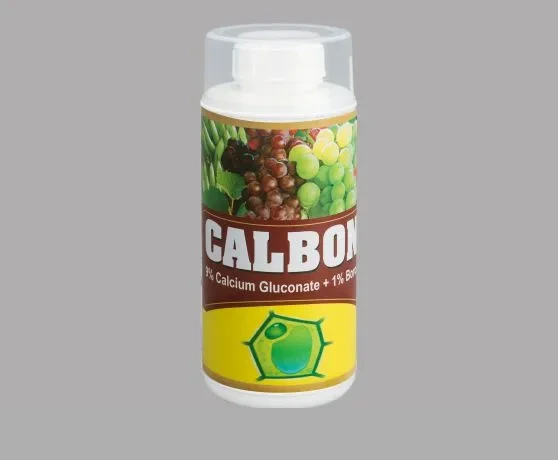
Calbon

Calbon
Manufactured by: Cam Ferti, S.L. Spain

Home → Fertilizers / Chemicals → CALBON

Calbon

Organically Chelated Calcium

Calbon is a premium calcium and boron supplement designed to support healthy plant growth, improve fruit setting, and prevent calcium and boron deficiencies. Ideal for enhancing crop yield and quality in fruits, vegetables, and flowering plants.

Note: Delivery charges will be extra.

₹1,200.00

₹5,600.00

Calbon is a premium calcium and boron supplement designed to support healthy plant growth, improve fruit setting, and prevent calcium and boron deficiencies. Ideal for enhancing crop yield and quality in fruits, vegetables, and flowering plants.
1. Water Soluble Calcium (CaO): 9%; Water Soluble Boron: 1%. 2. Chelating Agent (Heptagluconic Acid): 100%. 3. Colour: Light Brown. 4. pH: 2.3. 5. Density: 1.3 g/cc. 6. Free from chloride, sulfate, and nitrate.
1. It is immobile & remains in older tissue. 2. Calcium is a primary constituent of cell walls & membranes and is involved in production of new growing parts & root tips. 3. Deficiency of Calcium will adversely affect cell division; impair structural stability & permeability of cell walls. 4. Increase of Calcium in Fruit, promotes longer storage life & resists a range of Physiological breakdown conditions (such as water core, Bitter pit, internal browning in Apples, Tip burn in Lettuce, Internal Rust spots in Potatoes & Blossom End Rot in Tomatoes, Bud Necrosis in Grapes) etc. 5. Due to stronger cell walls provided to the plant by Calcium, Fungal spores are less likely to penetrate and germinate in host cells. 6. Crops that suffer from diseases like Botrytis, Rhizoctonia, Pythium, & Fusarium can have greater resistance to such fungal attacks.
1. Excessive dry or wet soils. 2. Excessive Potash in soils. 3. Upper leaves are distorted & curled at edges. 4. Leaves may have yellow bands. 5. Leaves may turn brown & die. 6. Roots develop poorly, are short & chubby, turn brown at an early age, and have few root hairs. 7. The leaves of some plants hook downward and exhibit marginal necrosis. 8. In blossom end rot, pale brown sunken areas develop around the blossom end (e.g. Tomatoes). 9. Flower buds fail to develop. 10. In Grapes, Calcium deficiency creates bud necrosis in the grape bunch.
1. Slow root development. Roots may develop a dark color and in severe cases the growing point may die. 2. New leaf growth may slow and leaf tips may stick together. Calcium does not readily translocate within the plant, so deficiency symptoms appear on new growth. 3. Poor nodulation by nitrogen-fixing bacteria on leguminous plant roots. Ineffective nodules are white to grayish green inside while healthy nodules have dark pink interiors. 4. Blossom end rot in tomatoes. Calcium and proper water management improve plant resistance to this problem. 5. Aborted and shriveled fruit on peanuts. A shortage of calcium at "pegging" results in a high percentage of "pops". 6. Darkened plumule or "black heart" in peanut seed, reducing yield, quality, and crop value. 7. Pod rot diseases on peanuts. Pods are predisposed to fungus infections when calcium is deficient or out of balance with Mg and K.
Apples: To prevent bitter pit — 5 applications beginning at petal fall. Grape: Improved fruit finish & storage — 5 applications from beginning of berry setting to maturity. Oranges: To increase fruit firmness — 2–3 applications. Strawberry: To increase fruit firmness — 3 applications. Cabbage, Lettuce, Cauliflower: To prevent tip burn — 2–3 applications starting at head formation. Cucumber, Melons, Capsicum, Tomatoes: To prevent blossom end rot — 3–6 applications from flowering & in times of heat stress. Potatoes: To prevent internal brown spot — 3–6 applications from flowering & in times of heat stress. Apples: To prevent bitter pit — 5 applications beginning at petal fall. Onion: To prevent tip burn, for larger onions with better storability — 6-leaf stage onward, 2–4 sprays. Vegetables: To get crisp, firm vegetables with shiny appearance — 2 sprays at flowering to fruiting. Groundnut: To improve quality & yield — 2–3 sprays beginning at pegging. Leafy vegetables: For freshness and shiny appearance — 1 spray 8–10 days before harvest. Ornamentals: To increase vase life — weekly application with pesticides.
  • Free from chloride, sulfate and nitrogen — safe to use during fruiting, flowering, and maturity
  • Applied as a foliar fertilizer, absorbed directly by leaves, shoots and fruit
  • Helps reduce sun damage
2 ml/Liter for foliar application.
1. Not for Human / Medicinal use. 2. Keep away from Eyes & Skin.
Calbon is manufactured by Cam Ferti, S.L. in Spain.