

 |
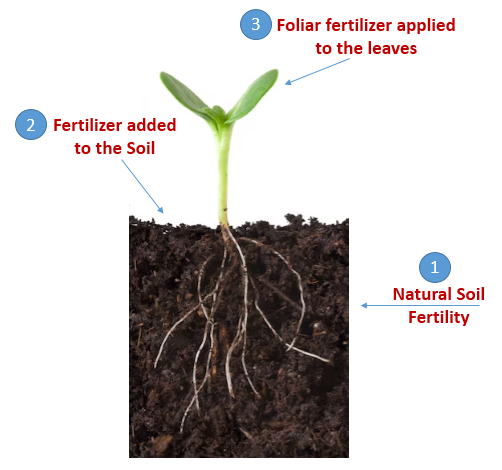
| Ways by which plants can obtain nutrients |
Essential plant nutrients, forms taken up and their typical concentration in plants (adopted from Roy et al 2006) (reference: Env. Biodiv. Soil Security Vil. 1 (2017)
|
Nutrient (symbol) |
Forms absorbed |
Typical concentration in plant dry matter |
|
|
Macronutrients |
|||
|
Nitrogen (N) |
NH4+ , NO3- |
1.50% |
|
|
Phosphorus (P, P2O5) |
H2PO4-, HPO42- |
0.1–0.4% |
|
|
Potassium (K, K2O) |
K+ |
1–5% |
|
|
Sulphur (S) |
SO42- |
0.1–0.4% |
|
|
Calcium (Ca) |
Ca2+ |
0.2–1.0% |
|
|
Magnesium (Mg) |
Mg2+ |
0.1–0.4% |
|
|
Micronutrients |
|||
|
Boron (B) |
H3BO3, H2BO3- |
6–60 µg/g (ppm) |
|
|
Iron (Fe) |
Fe2+ |
50–250.µg/g (ppm) |
|
|
Manganese (Mn) |
Mn2+ |
20–500.µg/g (ppm) |
|
|
Copper (Cu) |
Cu+ , Cu2+ |
5–20.µg/g (ppm) |
|
|
Zinc (Zn) |
Zn2+ |
21–150.µg/g (ppm) |
|
|
Molybdenum (Mo) |
MoO42- |
below 1.µg/g (ppm) |
|
|
Chlorine (Cl) |
Cl- |
0.2–2 percent |
|
Essential nutrients for plant growth, their mobility within the plant and role in plant physiology.
|
Nutrients |
Symbol |
Mobility of nutrient inside plant |
Important functions in plant |
|
Nitrogen |
N |
Yes |
Formation of amino acids, vitamins and proteins; cell division |
|
Phosphorous |
P |
Yes |
Energy storage and transfer; cell growth; root and seed formation and growth. |
|
Potassium |
K |
Yes |
Carbohydrate metabolism and translocation; water efficiency; fruit formation; winter hardiness; disease resistance |
|
Magnesium |
Mg |
Yes |
Chlorophyll production; phosphorus mobility; iron utilization; fruit maturation |
|
Chlorine |
Cl |
Yes |
Maintaining electrical charge balance, improvement of water balance and osmoregulation. |
|
Molybdenum |
Mo |
Yes |
Nitrate reductase formation; conversion of inorganic phosphates to organic |
|
Nickel |
Ni |
Yes |
Nitrogen metabolism and fixation; disease tolerance |
|
Calcium |
Ca |
No |
Cell division and formation; nitrogen metabolism; translocation; fruit set |
|
Sulfur |
S |
No |
Amino acids formation; enzyme and vitamin development; seed production; chlorophyll formation |
|
Boron |
B |
No |
Pollen grain germination and tube growth; seed and cell wall formation; maturity promotion; sugar translocation |
|
Copper |
Cu |
No |
Metabolic catalyst; functions in photosynthesis and reproduction; increases sugar; intensifies color; improves flavor |
|
Iron |
Fe |
No |
Chlorophyll formation; oxygen carrier; cell division and growth |
|
Manganese |
Mn |
No |
Involved in enzyme systems; aids chlorophyll synthesis; P and CA availability |
|
Zinc |
Zn |
No |
Hormone and enzyme systems; chlorophyll production; carbohydrate, starch and seed formation |
Availability of plant nutrients in the soil is dependent on several factors which have a profound influence on the plant’s ability to absorb & utilize micronutrients from soil.
- Soil factors
- pH
- Redox potential.
- Biological activity
- SOM
- CEC
- Clay content
- Root and root hair morphology (length, density & surface area)
- Root induces changes (secretion of H+, OH- & HCO3)
- Root exudation of organic acid (citric acid, malic acid, tartaric acid, oxalic acid, phenolic)
- Sugars & non proteogenic Amino acids (photo siderophores, secretions of enzymes(phosphatase), plant demand, plant species cultivar & microbial association (rhizobium, rhizobacterial)
- Enhanced CO2 production
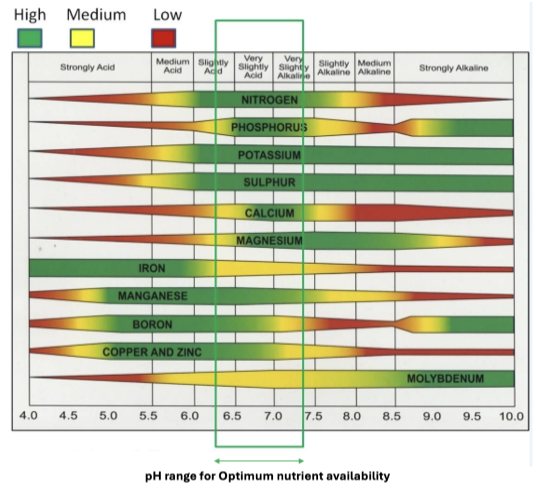
- Soil pH – most plant nutrients are best available between pH of 6.2 to 7.3
- High amount of phosphate & calcium present in the soil solution hampers absorption of plant nutrients.
- High Organic matter content
- High clay content
- Antagonism between nutrients.
Besides the above, the other important factor responsible for nutrient uptake is root system which is affected by several factors as given below.
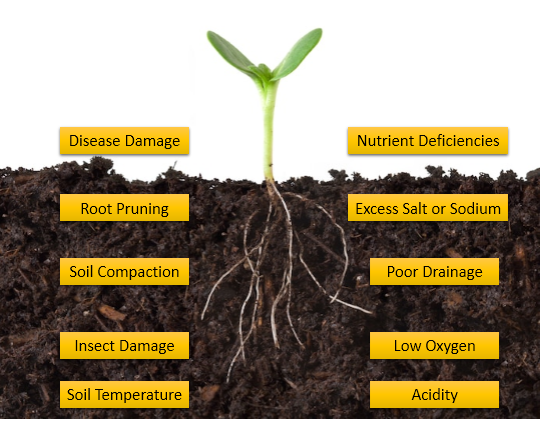
Chart showing availability of Plant nutrients at various pH.
Nutrient Deficiencies:
- By the time deficiencies are visible, yields have been reduced.
- Nutrient deficiencies are best treated with a regular maintenance program (based on soil and petiole analysis) using foliar applied nutrients to prevent deficiency and to improve quality and yield of crop.
Foliar Application of plant nutrients.
- Foliar fertilization is defined as the foliar spray or application of one or more essential plant mineral nutrients on above-ground plant parts. A large number of plant nutrient are soluble in water & may be applied directly to the aerial portions of plants. The applied nutrients can enter the leaves by penetrating the cuticle or by entering through the stomata, before entering the plant cell where they can be used in metabolism (Oosterhuis and Weir 2010).
- Foliar application of micronutrients has been documented as early as 1844, when an iron sulphate solution was sprayed. (Pace 1982).
Leaf is not the main organ for nutrient uptake. It is neither practical nor efficient to apply all nutrients through leaf. For proper function of photosynthesis, the leaf surface should remain clean.
When Foliar Application is Needed?
- Even if soil fertilization is optimal, under weather conditions such as too hot, too dry, too wet etc. plant nutrient uptake is low.
- During stages of rapid plant growth
- During critical stages of development, such asflowering, fruit set, and fruit maturity when low nutrient availability may cause yield reductions
- It is beneficial to apply immobile plant nutrients such as Calcium and Boron by foliar for quick entry into fruits and vegetables.
- In many crops, root activity declines whereas crop requirements are high and supplementing nutrition by foliar is a good mechanism.
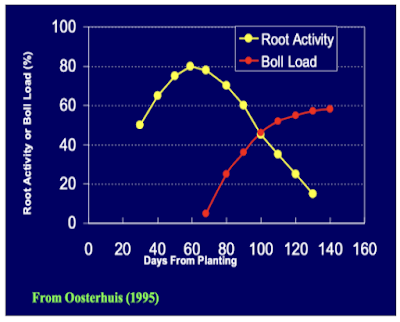
Advantage of Foliar Fertilization over Soil Fertilization.
Soil Application:Nutrients are tied up, it is slow acting, less efficient, soluble nutrients are prone to Leaching.
Foliar Application:Foliar applications are faster acting and more efficient
- Faster uptake (within hours) for e.g. foliar applied urea is absorbed to the extent of 30% within 1 hour and 60% in 24 hours.
- More efficient (3-100 times)
- No tie up by soil, No leaching
- Supplements soil applied fertilizer
- Big response at relatively low cost
- Only small amounts of fertilizer used
- Improves yield & quality of fruits, vegetables and fiber.
Relative Nutrient amounts required for comparable effect in the plant.
|
Nutrient |
Crop |
Foliar |
Soil |
Source |
|
Magnesium |
Sorghum |
1 |
100 |
Krantz (1962) |
|
Iron |
Sorghum |
1 |
25 |
Withee & Carlson (1959) |
|
Phosphorus |
Beans, Tomatoes |
1 |
20 |
Wittwer, et al. (1957) |
|
Zinc |
Annuals |
1 |
12 |
Lingle & Holmberg (1956) |
|
Element |
Plant Treated |
Time required for 50% Absorption |
|
Nitrogen |
Apple |
1 to 4 hrs |
|
Pineapple |
1 to 4 hrs |
|
|
Sugarcane |
< 24 hrs |
|
|
Tobacco |
24-36 hrs |
|
|
Coffee, Cacao |
1 - 6 hrs |
|
|
Banana |
1 - 6 hrs |
|
|
Cucumber, Bean, Tomato, Corn |
1 - 6 hrs |
|
|
Celery, Potato |
12 - 24 hrs |
|
|
Phosphorus |
Apple |
7 to 11 days |
|
Bean |
30 hrs - 6 days |
|
|
Sugarcane |
15 days |
|
|
Potassium |
Bean, squash |
1 to 4 days |
|
Grape |
1 to 4 days |
|
|
Calcium |
Bean |
4 days |
|
Magnesium |
Apple |
20% in 1 hr. |
|
Sodium |
Bean |
6 hr. |
|
Sulfur |
Bean |
8 days |
|
Chlorine |
Bean |
1 to 2 days |
|
Iron |
Bean |
8% in 24 hr. |
|
Manganese |
Bean Soybean |
24 to 48 hr. |
|
Zinc |
Bean |
24 hr. |
|
Molybdenum |
Bean |
4% in 24 hr. |
Application efficiency via Foliar & Soil: Foliar applied nutrients can improve plant yield by 15-19% and quality by 9-29%
Exogenous and environmental factors affecting foliar fertilization: Light intensity, temperature, wind speed, time of day, photoperiod, humidity, amount and intensity of precipitation, drought, osmotic potential of growing medium (or soil water), and nutrient stress affects performance of foliar fertilization.
Endogenous factors: The uptake efficiency depends on the thickness of the cuticle covering epidermal cells (green shoots, lower and upper leaf surfaces) as well as the number of cuticular pores and ectodesmata located in this layer.
Mechanism of Foliar Fertilization
- For a foliar fertilizer nutrient to be utilized by the plant for growth, it must first enter the leaf prior to entering the cytoplasm of a cell in the leaf.
- To achieve this the nutrient must effectively penetrate the outer cuticle and the wall of the underlying epidermal cell OR gain entry through stomata.
- Once penetration has occurred, nutrient absorption by the cell is like absorption by the roots.
- The cuticle offers the greatest resistance to foliar-applied nutrients.
Stomata
- are small pores in epidermal surface of leaves and on some stems. Most stomata are present on the abaxial (lower) surface. In many plant species there are no stomata on the adaxial (upper) surface.
- The stomata have a raised liplike structure which prevents direct entry of water and are further protected by guard cells which open and close the stomata.
- Water with low surface tension may enter stomata = stomatal flooding, (especially by use of super spreading adjuvants).
- Size of stomata on the epidermis of leaves is between 3-12 micron in width and 10-14 micron in length. Total area of stomata is usually less than 3% of total leaf area.
- The number of stomata per cm2 of leaf surface varies from 1000−60,000 or 10−600/mm
- Opening of pores depends upon water condition –completely open by 10 am. They remain wide open until 2.30 pm and are mostly completely closed by 5 pm. On hot days they may close even at 12 noon.
Thus, it is not that easy for nutrients to enter leaf through stomata. In other words, only a small amount of water-soluble nutrient can gain entry through stomata. Besides stomata, there are aqua pores present on the cuticle which also facilitate uptake of nutrients.
Movement of Nutrients through the Cuticle:
- The leaf Cuticle is a thin covering on the outside of the leaf and other organs which protects the plant from the extremes of the environment.
- Recent physiological studies have identified polar aqueous pores which facilitate absorption of charged ions into the epidermal cells (Schonherr, 2000).
- Cuticles are traversed by numerous hydrophilic pathways permeable to water and small solute molecules (Marschner, 1995).
- These pores have a diameter of <1nm, with a density of about 1010 pores/cm (Schonherr, 1976) and are lined with negative charges increasing in density towards the inside, facilitating movement of cations (Tyree et al., 1990).
- Actual movement through the cuticle depends on the nutrient concentration, molecular size, organic or inorganic form, time during which nutrient solution remain on the leaf surface, charge density across the cuticle etc.
- The cuticle is dynamic and responds to changes in the environment and to management: e.g. drought stress and extreme temperatures.
Besides the tiny size of stomata and cuticular barrier there is one more factor i.e. the charge on the nutrient particle or ion. The leaf has a negative charge and like charges repel and opposite attract. This is very important point which must be considered.
Absorption of foliar applied nutrients is rapid and complete when the leaves are young. As the leaves ages, the permeability decreases and, the waxy layer in cuticle increases.
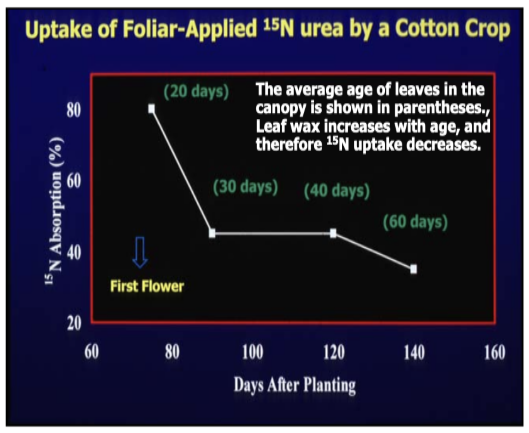
Changes in the Leaf Cuticle with Water Deficit Stress
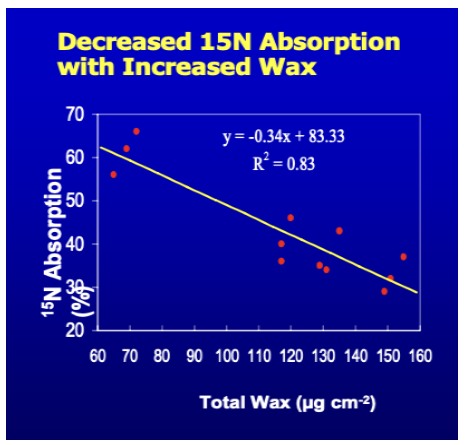
- Cuticle thickness increases by 33%.
- Cuticle composition changes to predominantly high molecular weight (longer chain) waxes which increases the hydrophobicity.
- This causes a decrease in uptake of agrochemicals (From Oosterhuis et al., 1991)
Meteorological conditions favouring foliar applications:
|
Time of the day |
Late evening; after 6:00 p.m. Early morning; before 9:00 a.m. |
|
Temperature |
18-30 oC ; 21 oC ideal |
|
Humidity |
greater than 70% relative humidity |
|
Delta T |
2-8 |
|
Wind Speed |
less than 5-7 kph |
To enhance foliar efficiency:
- High volume sprays with addition of humectant are useful to prolong life of droplet / water film on the surface to facilitate absorption / penetration. Small droplets of water evaporate very quickly, depositing dry nutrient content on leaf surface which may not be taken up until they are rewetted by rain or fog.
- Leaf and stem tissues can prevent initial nutrient absorption by means of waxy substances in the cuticle, pubescence and drooping or erect leaf angles.
- Effective foliar applications depend on maximum absorption of soluble nutrients, avoiding losses due to evaporation and/or runoff as much as possible.
- To achieve maximum nutrient absorption via foliar applications, spray application giving good coverage with addition of super spreading and super penetrant is important.
- Acidifiers / stabilizers added to the foliar fertilizer solution to stabilize pH at 5.0 and 6.0 are very useful.
- Foliage burn can be caused by a high concentration of fertilizer salts and due to being deposited on the edge of leaves.
The penetration of nutrients into the leaf cells through the waxy layer of the cuticle occurs passively (without energy expenditure). The rate of penetration of nutrients into the leaves depends on the concentration of the solution and how long it remains on the leaf.
Organic as well as inorganic elements can be taken up by the leaves. Since the total requirement of N,P,K and Ca, Mg S are higher, it is advisable to provide them through soil or fertigation in one or more split(s). Deficiencies if any, arising out of unfavourable weather conditions can be met by foliar application.
Micronutrients such as Fe, Mn, Zn, B, Cu, Mo are required in small quantity by the plants, and it is possible to supply total quantity through foliar spraying but especially in critical growth stages.
Micronutrients are available in dry & liquid form, as well as in various chemistry & concentrations.
The comparative differences between different types of micronutrients are given below.
Sulfates:
Advantages:
- Contains basic nutrients and sulfur in sulfate form.
- Easily available / inexpensive
Disadvantages:
- Stability and availability dependent on pH
- May cause phytotoxicity
Chlorides:
Advantages:
- Easily available / inexpensive
Disadvantages:
- May cause phytotoxicity and scorching / burning if used in inappropriate amounts
- May reduce product quality, taste and shelf life.
Nitrates:
Advantages:
- Quickly available / inexpensive
- Suitable for use during the period of vegetative growth, but not after flower/ fruit setting.
Disadvantages:
- Excess nitrogen can cause leaves to become soft and invite pests / diseases.
Oxides/Carbonates/Hydroxides:
Advantages:
- Inexpensive
- Sticks to leaves.
- High analysis
Disadvantages:
- Low bioavailability
- Suspension (SC formulation), unsuitable for drip irrigation.
- Lower shelf life
Chelates and Complexes:
Many times, micro-nutrients are chelated or complexed. Micro-nutrients are basically chelated to prevent unwanted reactions taking place between the nutrients in the soil. Such reactions can render one or both nutrients to become unavailable to the plants. Some nutrients become unavailable to the plant due to unfavorable soil pH. Hence, use of chelated micro-nutrients is very important to ensure availability of those nutrients to plants.
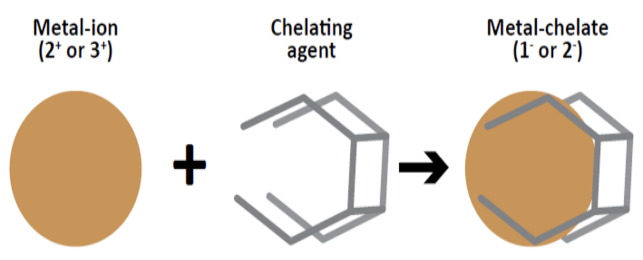
Metal cations can be chelated, thus we have chelates of Ca++, Mg++, Mn++, Fe++, Fe+++, Zn++, Cu++, Co++. Anions cannot be chelated. Hence, it is not possible to chelate Boron, Molybdenum & Sulphur. However, anions can be complexed, a process in which the bonds are not as strong as the coordinate bonds formed by chelation.
There are many natural, organic chelating agents such as organic acids, amino acids, lignosulfonates, lignin polycarboxylates, sugar acids and derivatives, phenols, polyflavonoids, siderophores and Phyto siderophores. Several synthetic chelating agents have been developed for use in agriculture & industry. Both natural & synthetic chelating / complexing agents increase solubility and availability of micro-nutrient to plants.
Advantages of Chelates:
- Chelates are molecules with neutral charge. The neutral charge of chelated minerals allows them to enter the stomata without hindrance. (However, molecular size of chelates is another important factor.)
- Greater bioavailability: - Bioavailability is the degree & rate at which a substance is absorbed into a living system or is made available at the site of physiological activity.
- Molecular size of chelating agent is very small and can facilitate quick absorption, transmission through xylem.
Should chelated micronutrients be used for foliar application.?
- Since, there are no other nutrients present on the leaf to interfere and react, do we need to use chelated micronutrients? Chelation offers various advantages even for foliar applications.
- Neutralisation of charge on cations such as Fe++, Ca++, Mg++, Zn++, Mn++, Cu++ to facilitate entry into leaf epidermis.
- To improve solubility and availability
- If the size of chelating agent is small, it will quickly gain entry through stomata and micropores
- The chelating agent may lower the pH of spray solutions and effect of hard water on the metal micronutrient. (especially Fe)
In agriculture EDTA are widely used chelating agent for micronutrients. (other synthetic chelates such as DTPA, HEDP also have similar properties)
Disadvantages of EDTA:
- Due to the large size of the EDTA molecule, it is difficult to enter the plant through the leaves
- Not biodegradable
- The stability of chelated iron depends on pH
- EDTA cannot stay separated from metal cation. Thus, synthetic chelate such as EDTA will release one metal and capture the other, e.g. zinc EDTA releases zinc to the plant, while the free EDTA molecule must captures other nutrient such as calcium.
- In some plants, the EDTA molecule can cause phytotoxicity
- Metals are bound too tightly to the EDTA molecule
- Relatively small amounts of metals can be chelated
- Expensive
For chelated products to be effective, the metal and the chelating agent (EDTA) must be processed in the right amount by molar ratio. Only 100% chelated micronutrient can provide intended performance. It must be noted that, synthetic chelates are stable within a pH range as given below. Chelated iron is specially challenging due to its sensitivity to pH and other factors such as carbonate / bicarbonate, presence of Calcium, redox potential.
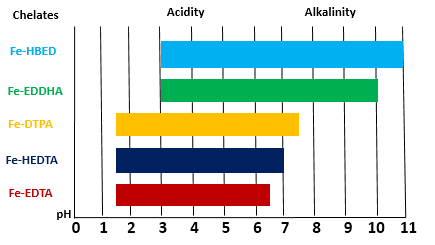 |
| pH stability of various Iron chelating agents. |
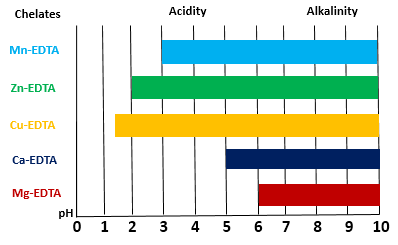 |
| pH stability of various EDTA chelated micro-nutrients |
Lignosulphate Complexed Micronutrients:
Advantages:
- Readily available
- Organic & Biodegradable
Disadvantages:
- In complexation, the metal is loosely bound to organic matter
- Relatively small amounts of metal can be 100% complexed
- Expensive
Carboxylic Acid, Gluconic acid, Heptagluconic Acid Complexed Micronutrients:
Advantages:
- Biodegradable
- Completely stable in alkaline pH solution
- Easy translocation of minerals into the plant due to low molecular weight
Disadvantages:
- Relatively small amount of metal can be 100% complexed
- Expensive
Amino Acid chelates / Glycine chelates / Carbohydrate chelates / Organic acid chelates:
- Are organically chelated foliar fertilizers
- Small molecular size facilitates fast entry into the leaves and plant cells
- 100% available to plants
- Biostimulant action besides chelation of micronutrients
- Metals completely chelated with amino acids are neutral in charge. Therefore, they freely pass through this barrier. When the amino acid chelates reach the cell membrane, they are recognized as a source of organic N. As a result, entire amino acid chelate is taken into the cell very rapidly, efficiently and translocated and metabolized by plant
- Large molecules can only enter via stomata • Stomata are open only part of the time • Natural amino and carboxylic acids can enter via stomata and directly through leaf epidermis
- Immobile elements – are not readily relocated from old to young tissues. When zinc (or other element) is chelated with glycine, the plant recognizes molecule as a protein and allows it to travel in the phloem, to the growing points. The speed of transport is also very fast in the case of Glycine /amino acids chelated products.
It is important to note that plant nutrients must be inside the plant and not on the plants.
सदर लेखमालेतील लेख आवडला असल्यास इतरांना या लेखाची लिंक पुढे पाठवा तसेच या ब्लॉगला फॉलो (Follow) करा. Follow करण्यासाठी https://ecoagroservices.blogspot.com/ या लिंकला जा व पान उघडा. पानाच्या खालच्या उजव्या कोपऱ्यात  या चौकटीवर क्लिक आहे, त्यावर क्लिक करा. नवीन लेख प्रकाशित होताच त्याची सूचना तुम्हाला ई-मेल द्वारे प्राप्त होइल.
लेखाबाबत काही प्रश्न / सूचना असल्यास आपण ecoagropune@gmail.com या ई-मेलच्या माध्यमातून आम्हाला पाठवू शकता.
लेखाबाबत काही प्रश्न / सूचना असल्यास आपण ecoagropune@gmail.com या ई-मेलच्या माध्यमातून आम्हाला पाठवू शकता.